Village Vandi


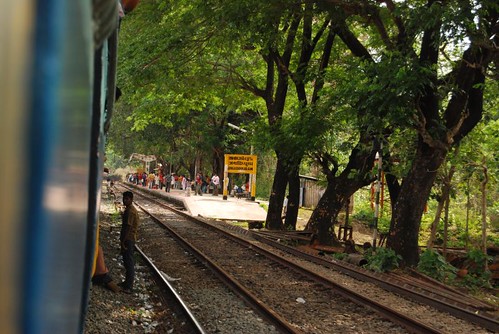
Time is around 9am when I and my parents reached our local railway station, Vaniyambalam. Station is painted with a glowing yellow and green color. One luxury car and two or three autos are waiting in front of the station. A few people are standing in the queue infront of the ticket counter. We already got our tickets from the stationary shop nearby.

Here there is no announcements, no advertisements; everything is quiet except the murmuring of the crowd waiting. Six trains run through this track though the starting point is always Nilambur and finishing point is Shornur. It is a typical village station where you can see people talking to almost everyone they meet.

Oh! Train is coming. Roaring, waving apart all the branches of trees and bushes that stood in its way, the giant vehicle entered in a royal manner. We got seats and I could hear someone screaming at others, “Why do you’ve to simply rush like this? Just like a bus, driver of this train will make sure that no one is left in the platform before starting the train. He even gets down sometimes in some stations to have a stretch and relax”.

Ha-ha! That makes this train service unique.

Hmm… train is moving now! Another specialty of the route is there is no city coming in between. It flows through villages and woodlands. As the train reached next station, I found a single window seat empty. With my cell phone playing my favorite music collections, I settled there. The guy sitting next to me is busy sleeping. And the family sitting adjacent to my seat is busy discussing about their daughter’s marriage with a moulavi.

Paddy fields, teak forests, small houses, rivers… Train is moving as if it is bored of seeing same scenes again and again! Even for me, it’s nothing new… I’d traveled many times in this train in last two years.

Pardesi… pardesi… Jana nahi”, a lady holding her kid is seeking alms from the fellow travelers. Another person is selling local home-made snacks. “Randennam 10, moonennam 10…Aadayakaramaya vayanakku… (Two things for Rs.10, Three things for Rs.10! For a profit read)”, a guy moves through the compartment with a bundle of old magazines. Each train will have characters like these that make it alive. Kids waving hands at the train, villagers washing their buffalos, cattle grazing in the paddy fields and vehicles waiting impatiently near railway gates; all scenes passing like a flash…

Train stopped in Angadipuram station. This station was beautifully captured in the movie Krishnagudiyil oru Pranayakalath. It has a small break here until its counterpart reaches from Shornur. There is no level cross in this track and so the train that comes first has to wait for the other. And so my train slept until its friend vanished. When the other one left, my train woke up and started moving.

Train is heading towards Shornur station, the biggest of the state where you can see trains moving in all directions like worms. As usual, it ended its journey in the second platform. We rushed towards sixth platform and got into Parasuram Express.

“Train No. 2341, Shornur-Nilambur Road passenger is on platform no. 2”… I heard it several times. There are express trains like Sabari and Parasuram resting unnoticed. Remembering my TTR friend Sandeep’s words, “Whatever it is, the announcement is done the most for the Nilambur train”…

Parasuram got up from its catnap and slowly moved on. I could hear announcements in full swing along with ad jingles informing people about the train in second platform. The village passenger is getting ready for another ride with another set of rural folks….

Read more...

Royal slips


Three years ago, an award-winning director stepped into their house atop a hill in Pazhassi in North Kerala’s Kannur district. It wasn’t a surprise; for the past 70 years, they have had visitors—scholars, historians, researchers—who came knocking for the story of their granduncle, the legendary Pazhassi Raja Kerala Varma. It was all the attention they got; mainland Kerala otherwise hardly knew of them. They led a mute life sans the aristocracy of the times when the freedom fighter ruffled many a feather on the British crown.

When Hariharan, the director, came to Syamakrishna Vihar asking Shankara Varma, the present head of the family, for details on Pazhassi Raja, the local media went to town with it. The Pazhassi family is centuries old, and is an offshoot of the Kottayam Kovilakam, the royal clan of a hamlet in Kannur. Varma, a renowned Carnatic musician and disciple of Chembai Vaidyanatha Bhagavathar, was one who performed the rites for Pazhassi Raja, when an astrological enquiry showed ‘his soul is yet to be liberated from wordly ties and attain moksha’. Hariharan’s visit coincided with Pazhassi Raja’s slow patronisation by cultural outfits in Kerala, a la Shivaji in Maharashtra. Many expected a big flick and the news that one was to be made didn’t come as a surprise.

Thus, even before the movie hit theatres, it had made headlines. It flaunted a glittery star cast, whizkids like Illayaraja and Oscar-awardee Rasul Pookutty behind the scenes and trends that Malayalam cinema has only longed for. It had its share of controversies, too, with the truck carrying horses for the shoot meeting with an accident and the movie’s maker going on a short court stint. The Pazhassi family’s accusation is right on time; the movie could help itself with a bit of controversy to buoy its fortunes. Hariharan, however, feels he and the movie would do a lot better without such controversies. “I am not interested in them (the controversies). I referred eight or nine books before getting into this project. So I do not think the movie is full blunder,” the director says.

Varma’s discontent with the movie does not just lie with the structure of the plot. He also feels the film has less of Kannur, Wayanad and Pazhassi in it, the places which were part of parcel of Pazhassi Raja’s valour. Also, places like Ezhimala, where war strategies were laid out against the British, and Pazhassi Madam temple, the warrior’s family shrine to which he was attached, do not appear in the movie at all. “The climax, too, doesn’t go with history,” Varma says. Pazhassi Raja dies after being shot at in the movie, when the way he died is still a mystery. The movie is also significantly oblivious of the road constructed through the middle of Pazhassi palace by the British after his death.

Historically, too, there are discrepancies, says Varma. “There is even a scene in the movie where Pazhassi Raja enjoys a Krishnattam performance,” he notes. Krishnattam can be performed only in Guruvayur temple or in the Zamorin’s palace. The movie crew incurred huge losses to shoot the scene. It was postponed thrice and locations shifted for each time. “If I had known about the scene, I’d have told them and so all these things may not happen.” Varma thinks such mishaps took place as the art form was taken out of its home premises.


Shankara Varma recollects narrating to Hariharan, the story he has literally grown up with for all of his 90 years. But the director was not very keen about the detailing; he, afterall, just wanted a movie with all the spices of a commercial hit. “May be the original didn’t have the flavour for a popular movie,” says Varma. The award-winning director left the story there, and promised to be back soon. The Pazhassi household still awaits his return.


(This article came in THE HINDU. Check out: http://www.hindu.com/mp/2009/11/23/stories/2009112350110400.htm)

Read more...

My Ping in TotalPing.com

Sexy Nude Celebrity Hot Female Celebrity